 Skip to content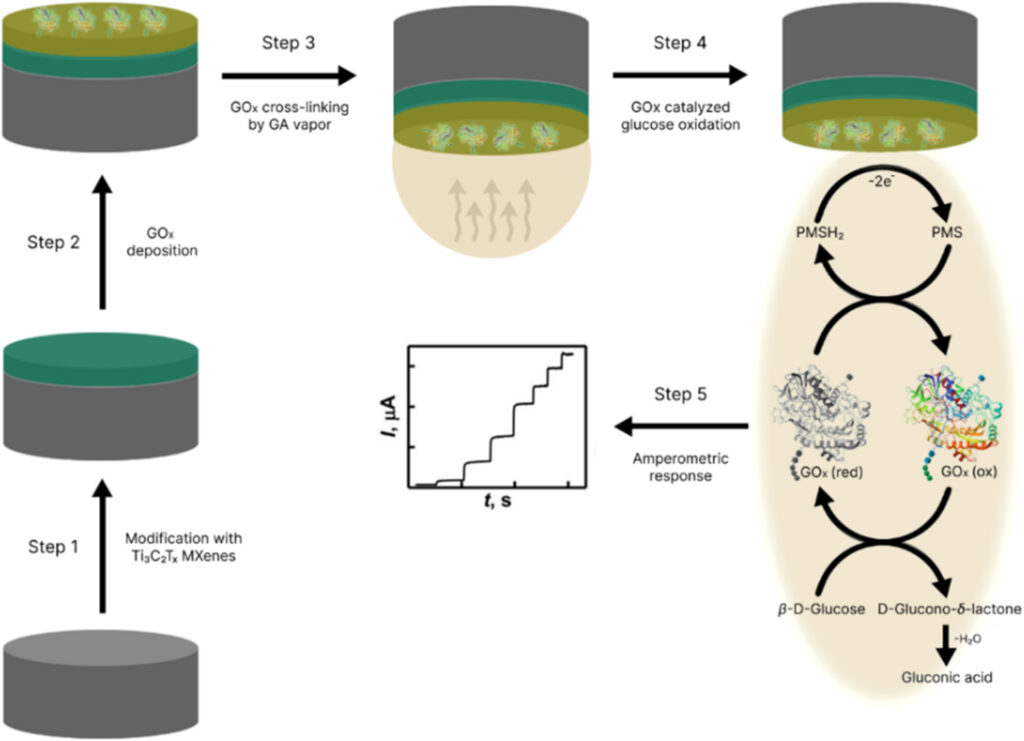
Boosting the Performance of Electrochemical Glucose Sensors with Ti₃C₂Tₓ MXenes. The work delivers meaningful perspectives on the potential of unmodified Ti₃C₂Tₓ MXenes (as opposed to composites) for advanced glucose biosensor applications. It emphasizes that optimizing surface properties, enhancing film stability, and selecting suitable polymers are crucial for achieving highly efficient sensor systems.
Diabetes remains a major worldwide health issue, affecting hundreds of millions and requiring continuous monitoring for proper management and prevention. This research examined the effectiveness of Ti₃C₂Tₓ MXenes as working-electrode modifiers in electrochemical glucose biosensors, resulting in notable improvements over conventional sensor configurations. The integration of Ti₃C₂Tₓ MXenes greatly boosted sensitivity and stability. The use of Nafion or Aquivion ionomers enhanced film homogeneity and adhesion, helping to overcome challenges associated with incomplete MXene coverage and unstable surfaces. Optimizing polymer concentration was shown to be essential for achieving the right balance between structural integrity, morphology, and electrochemical activity. Of the redox mediators evaluated, phenazine methosulfate (PMS) delivered the most effective electron transfer and overall sensor performance.
The MXene-enhanced biosensors offered:
-
A useful linear glucose detection range of 0.1–5 mM
-
Low detection limits ranging from 23 to 48 μM
-
High sensitivities of up to 97.5 μA mM⁻¹ cm⁻²
-
Strong repeatability and reproducibility
Additionally, the sensors successfully measured glucose in human serum, confirming their practical use potential.
This work highlights the promise of pristine Ti₃C₂Tₓ MXenes—not composites—as materials for future high-performance glucose biosensors. The findings stress the importance of fine-tuning surface chemistry, improving film stability, and optimizing polymer composition. Future investigations should explore MXene deposition methods, variations in flake size, and improved enzyme immobilization techniques to further enhance performance and long-term reliability in biomedical applications.